

Case StudyScalable Traffic Safety in Montgomery County
Safer roads require more than enforcement technology. They require an operating model that can keep pace with the ambition.
- Scalable road safety: Montgomery County is expanding an automated enforcement program that has supported its Vision Zero ambitions since its introduction in 1999.
- Rapid operational improvement: The new program achieved 99+% system uptime and reduced the average time from violation capture to final County review from 8–12 days to 1 day or less.
- Greater capacity without greater complexity: Processed case volumes increased by more than 100% in the first months of operation while Montgomery County retained policy control and access to program data.
- ITIS capabilities working together: VITRONIC leads the program, combining its traffic-safety and operational expertise SkyToll’s experience in operating complex mobility services and a transport back-office solution provided by TollNet.
Policy context and objectives
For Montgomery County, automated enforcement is not an isolated technology program. It is part of a broader commitment to Vision Zero and the goal of reducing fatalities and serious injuries on its roads. In 2024, the County reported 47 crash fatalities, compared with an annual average of 39 between 2016 and 2021.
The challenge was therefore to do more than renew individual systems. Montgomery County needed to increase enforcement capacity, accelerate case handling and maintain reliable operations—without adding the same level of complexity to its own organization.
Coverage and operating model
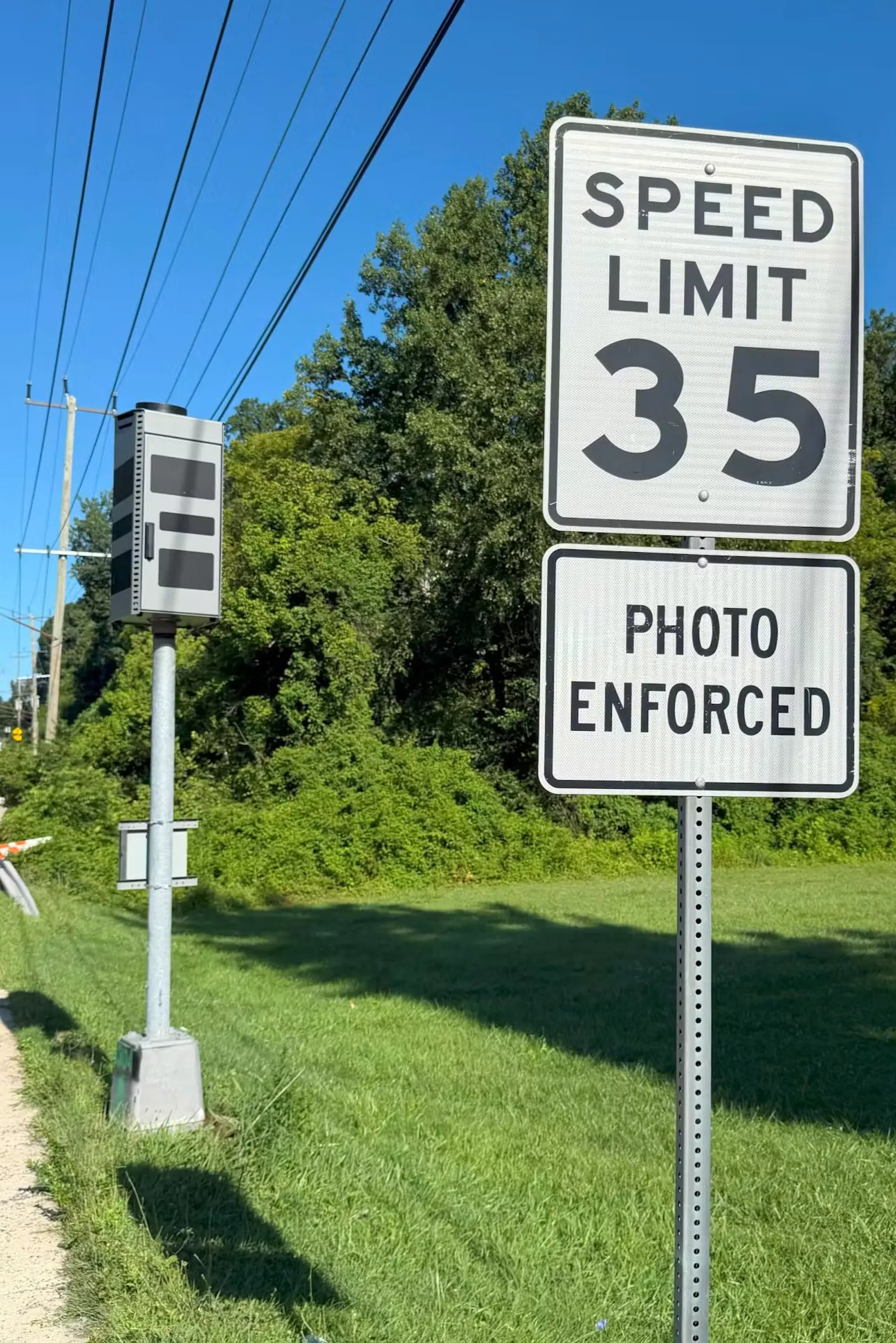
Implementation began on 1 November 2025. During a six-month phased rollout, 216 locations were equipped and activated across Montgomery County for applications including speed and red-light enforcement. The program is already being expanded to address further high-risk behaviors such as distracted driving, seatbelt violations and pedestrian safety.
The operating model is equally important as the coverage. Montgomery County retains oversight, policy authority and real-time access to program analytics. Our daughter company VITRONIC, specialist in safe mobility, takes responsibility for the day-to-day technical and operational work required to keep the program running.
Technology stack and compliance control
Behind that simplicity for the customer is a connected end-to-end process. Roadside detection, secure transmission, case processing, payments, court integration and reporting are brought together so that potential violations can move efficiently from detection to final review.
This is also where the wider ITIS model becomes tangible. VITRONIC leads the Montgomery County program and remains accountable for its delivery. At the same time, it draws on specialist competence from within ITIS group structure: SkyToll plays an important role in the end-to-end operating model, contributing experience from operating complex, mission-critical mobility services. SkyToll’s contribution is supported by the use of a transport back-office solution provided by Prague-based TollNet, which helps connect transaction processing with downstream administrative workflows. ITIS therefore does more than bring its operating companies under one roof. It creates the conditions for their competencies to reinforce each other.
Delivery scope and operational readiness
The result is not a collection of individual systems, but an end-to-end managed traffic-safety operation. VITRONIC covers the chain from planning and deployment through monitoring, violation processing, service, payments, reporting and continuous operational support.
Early results show what this changes in practice: system uptime reached more than 99%, final County review fell from 8–12 days to no more than one day, and processed case volumes increased by more than 100% in the first months.
The project also demonstrates the value of cooperation across ITIS. Specialized competencies can be shared between operating companies where they strengthen the customer solution, while responsibility remains where it belongs: close to the customer, with VITRONIC leading the program.
Conclusion
Montgomery County shows what scalable traffic safety looks like when technology, operations and institutional control are treated as one challenge. The authority gains greater capacity, faster processes and reliable operations without having to manage every underlying interface itself.
This is the ITIS vision of an integrated mobility environment in practice: Inspire by looking beyond individual systems toward the complete mobility challenge. Enable operating companies by giving them access to complementary capabilities across the group. Connect those capabilities so that what the customer experiences is not organizational complexity, but one coherent, scalable and trusted solution.